

I. Characteristic Testing Indicators: Determining the “Basic Constitution” of the Formulation
1. Saponification Value, Iodine Value, and Acid Value
(1) Saponification Value reflects the average molecular weight of fatty acids in phospholipids. The larger the molecular weight of the fatty acids or the higher the content of unsaponifiable substances, the lower the saponification value, making injection and absorption more difficult; conversely, smaller molecular weights or shorter fatty acid chains result in a higher saponification value, facilitating interaction with water phases, rapidly reducing oil–water interfacial tension, and forming emulsion systems. Therefore, phospholipids with high saponification values typically exhibit stronger emulsifying capabilities.
(2) Iodine Value measures the content of unsaturated fatty acids in phospholipids. A higher iodine value indicates more unsaturated bonds, making the phospholipid more susceptible to oxidation. Oxidation not only reduces lipid bilayer fluidity but may also lead to drug leakage, formulation aggregation, or even rupture.
(3) Acid Value reflects the level of free fatty acids in phospholipids and serves as an important indicator for assessing hydrolysis. An elevated acid value signifies phospholipid hydrolysis, which compromises the integrity of the lipid bilayer, causing premature drug release and adversely affecting encapsulation efficiency and sustained-release performance.
Table 1: Methods and Limits for Determining Saponification Value, Iodine Value, and Acid Value of Pharmaceutical Phospholipid Excipients
Indicator | Testing Method | Standard Limit | Source |
Saponification Value | Acid–Base Neutralization Method | Egg Yolk Lecithin: 185–212 | ChP2025 |
Iodine Value | Indirect Iodometric Method | Egg Yolk Lecithin: 60–73; Soybean Phospholipid: Not less than 75 | ChP2025 |
Acid Value | Titration Method | Egg Yolk Lecithin: Not greater than 20.0; Soybean Phospholipid: Not greater than 30 | ChP2025 |
Titration Method | Egg Yolk Lecithin: Not greater than 36; Soybean Phospholipid: Not greater than 20 | USP47-NF42 | |
Titration Method | Egg Yolk Lecithin (for Injection): Maximum 20.0 | EP11.0 | |
Titration Method | Soybean Phospholipid: Should be below 40; Refined Egg Lecithin: Below 25 | JP18 |
2. Peroxide Value and Methoxyaniline Value
These two indicators jointly assess the degree of oxidation in phospholipids. Peroxide value reflects primary oxidation products (such as peroxides), while methoxyaniline value indicates secondary oxidation products (such as aldehydes and ketones). Once oxidized, phospholipids not only accelerate their own hydrolysis but also compromise formulation structure, posing safety concerns. Therefore, strict control of these two parameters is crucial for ensuring long-term stability of liposomal formulations.
Table 2: Methods and Limits for Determining Peroxide Value and Methoxyaniline Value of Pharmaceutical Phospholipid Excipients
Indicator | Testing Method | Standard Limit | Source |
Peroxide Value | Sodium Thiosulfate Titration Method | Egg Yolk Lecithin: Not greater than 3.0; Soybean Phospholipid: Not greater than 3.0 | ChP2025 |
Lecithin: Not exceeding 10; Injection-grade Lecithin: Not exceeding 3; Egg Yolk Lecithin: Not exceeding 3 | USP47-NF42 | ||
Egg Yolk Lecithin (for Injection): Maximum 3 | EP11.0 | ||
Soybean Phospholipid: Should be below 10 | JP18 |
II. Component Content Determination Indicators: Precisely Controlling the “Functional Attributes” of the Formulation
1. Fatty Acid Composition
Phospholipids from different sources (e.g., soybean vs. egg yolk) exhibit significant differences in fatty acid composition. Unsaturated fatty acids (such as oleic acid and linoleic acid) enhance lipid membrane fluidity, whereas saturated fatty acids (like palmitic acid and stearic acid) render the membrane more rigid and stable. By modulating fatty acid composition, one can tailor the release behavior and in vivo distribution of liposomes.
2. Phosphatidylcholine (PC) and Phosphatidylethanolamine (PE)
PC and PE are the two major components of phospholipids. High PC content results in tightly packed lipid membranes, leading to high drug encapsulation efficiency and slow release; conversely, high PE content makes the membrane more deformable, accelerating drug release. In fat emulsions, combining PC and PE often yields more stable droplets, prolonging drug action duration.
3. Hemolytic Phospholipids (LPC and LPE)
LPC and LPE are byproducts formed during storage or processing due to phospholipid hydrolysis. They possess strong surface activity, potentially disrupting lipid vesicle or emulsion membranes, causing formulation aggregation, particle size increase, and severe stability issues. Pharmacopoeias worldwide set strict upper limits on their content to ensure controllable formulation quality.
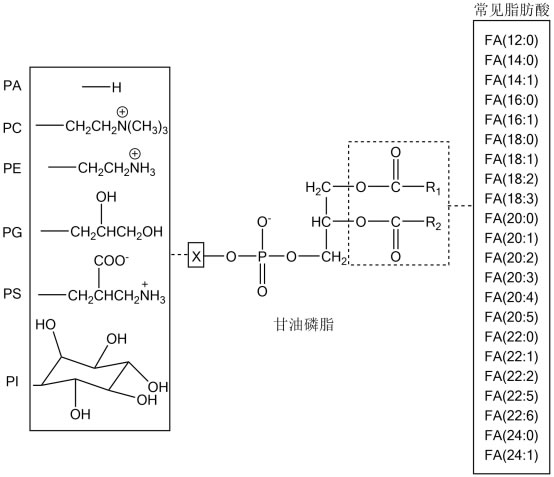
Figure 1: Fatty Acid Composition of Glycerophospholipids
III. From “Indicators” to “Therapeutic Efficacy”: Quality Is the Lifeblood of Formulations
The quality of phospholipid excipients not only affects physical stability but directly influences drug release behavior, in vivo distribution, and ultimate therapeutic efficacy.
In LNP (lipid nanoparticles), phospholipid chain length, saturation, and charge properties impact cellular interactions and delivery efficiency.
In injectable fat emulsions, the degree of phospholipid oxidation and hydrolysis directly correlates with formulation safety and shelf life.
Conclusion
Although pharmaceutical phospholipid excipients constitute a small proportion of prescriptions, they serve as the “behind-the-scenes heroes” determining formulation success or failure. From saponification and acid values to PC/PE content and hemolytic phospholipid limits, each quality indicator rigorously safeguards functionality and safety. With the continuous upgrading and refinement of Chinese Pharmacopoeia standards, we can confidently expect that more high-quality, functionally tailored phospholipid excipients will support innovative drug development, providing patients with safer, more effective treatment options.
Further Reading
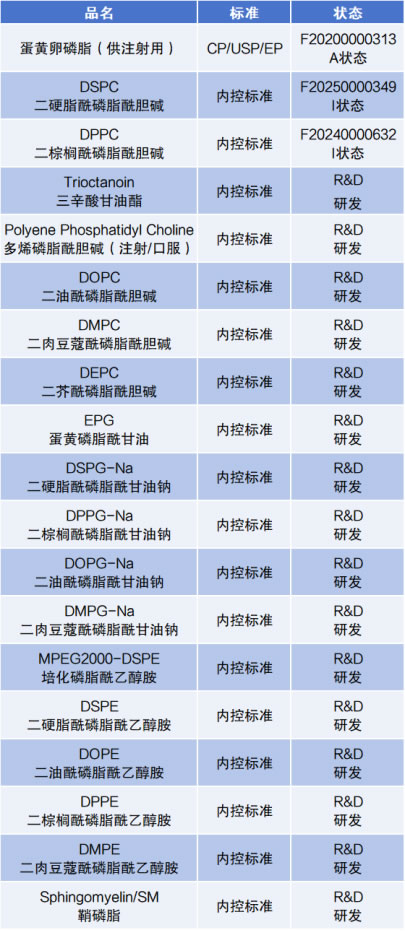
Guangzhou Baiyunshan Hanfang Modern Pharmaceutical Co., Ltd. is a national-level high-tech enterprise under Guangzhou Pharmaceutical Group, specializing in the research, development, and production of advanced pharmaceutical lipid raw and auxiliary materials. Currently, the company boasts mature approved products such as egg yolk lecithin and injectable cholesterol, while actively expanding its auxiliary lipid product line. DPPC and DSPC have entered practical application stages, and the company is simultaneously developing various phospholipid products at different R&D stages, including DOPC, DMPC, and egg yolk glycerophospholipid (EPG). By strictly adhering to international and domestic standards and leveraging cutting-edge production processes and quality control systems, Baiyunshan Hanfang is committed to providing end-to-end support—from mature excipients to innovative candidate materials—for global fat emulsion, LNP, and liposome formulation R&D, thereby driving technological breakthroughs and industrial advancement in the biopharmaceutical field!
Table 3: Product Information Table of Baiyunshan Hanfang’s Pharmaceutical Phospholipid Excipients (Partial)
References
Li Yaowei, Liu Wenqi, Yang Lin, et al. Interpretation of Key Quality Indicators for Pharmaceutical Phospholipid Excipients and Analysis of Their Impact on Drug Formulations [J]. China Pharmaceutical Standards, 2025, Vol. 26, No. 05: pp. 473–481.


